RAG, explained without the jargon: how AI actually 'remembers' your documents
Ever wonder how chatbots use your company docs? I break down RAG with a simple librarian analogy, explaining what it is, where it fails, and why it matters.
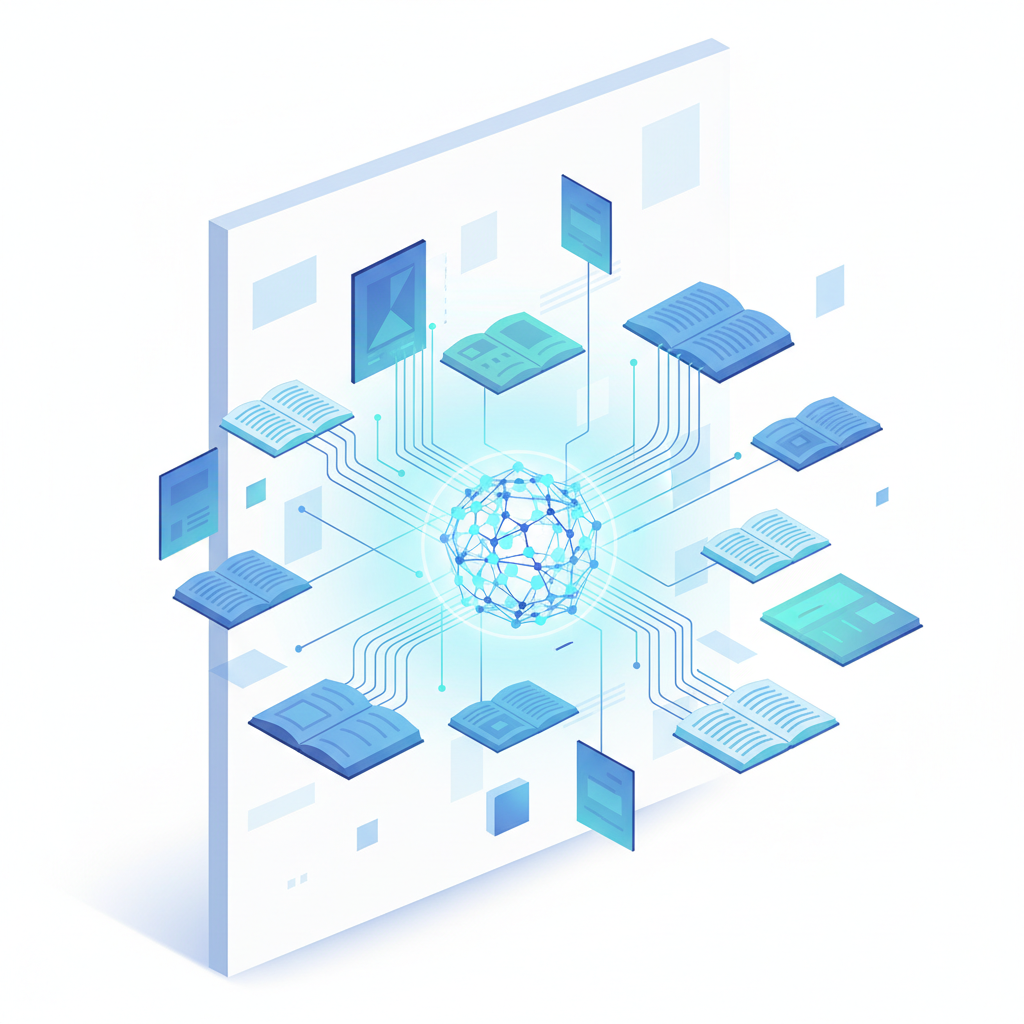
I spent a good chunk of my childhood in the quiet, dusty aisles of the local library in Pune. There was a particular librarian, a stern but brilliant woman named Mrs. Deshpande, who seemed to contain the entire Dewey Decimal System in her head. You could give her the vaguest description of a half-remembered book, and she wouldn't just find it for you; she would find three other books on the same shelf you didn't even know you needed. Building with AI today gives me a strange sense of déjà vu, because the most important new technique that makes chatbots actually useful is, in essence, hiring a digital Mrs. Deshpande for your AI. This technique is called Retrieval-Augmented Generation, or RAG, and it’s the secret sauce behind almost every “Chat with your data” app you see today.
The fundamental problem we're trying to solve is that a base Large Language Model, even a behemoth like OpenAI's GPT-4 or Anthropic's Claude 3, is a brilliant but profoundly forgetful genius. It’s been trained on a massive snapshot of the public internet, so it can write a sonnet, explain quantum mechanics, or draft an email with stunning fluency. But its knowledge is frozen in time. Ask it about the results of an election that happened yesterday or the key takeaways from my company's Q3 strategy meeting, and it will politely tell you it doesn't know. It has no access to private data, no memory of your conversations, and no knowledge of events after its training cutoff, which might have been months or even years ago. It’s like a historian who read every book published before 2023 and was then locked in a soundproof room.
So, how do we get this brilliant historian to write a report on our current company sales? We don’t try to re-teach them history from scratch. Instead, we give them a research assistant. This is the core idea of RAG. The LLM is our brilliant author, and the RAG system is the diligent librarian we hire to fetch them the exact documents they need, right when they need them. When I ask a RAG-powered chatbot, “What were our Q2 revenue targets?”, the question doesn't go straight to the LLM. First, the librarian (the retrieval system) sprints into action, finds the relevant internal documents about Q2 targets, and hands those specific pages to the LLM. Only then does the LLM, armed with the correct facts, generate the answer. It’s not remembering; it’s reading.
Before our digital librarian can fetch anything, they need to organize the library. You can’t find a needle in a haystack if the haystack is just one giant, tangled mess. If I point a RAG system at my company’s entire Google Drive—a chaotic collection of PDFs, slide decks, and thousand-page wikis—it will fail. The first step, then, is to pre-process this knowledge. The system breaks down every document into smaller, manageable “chunks.” This might be a paragraph, a few paragraphs, or a single slide. Think of it as the librarian tearing a giant encyclopedia into individual, standalone entries. Getting this “chunking strategy” right is one of the unsung, and surprisingly difficult, parts of building a good RAG system. Too big, and you introduce noise; too small, and you lose context.
Once we have our chunks, we need to index them so they’re searchable. This is where a bit of the magic—which isn’t really magic—happens, using something called “embeddings.” An embedding is just a long list of numbers, a vector, that represents the semantic meaning of a piece of text. Think of it as a set of coordinates. The system converts every single chunk into one of these numerical coordinates and stores them in a special kind of database, like those from Pinecone or Weaviate. The miracle here is that chunks with similar meanings get assigned similar coordinates. So, a chunk about “our company’s quarterly earnings” will be placed mathematically close to chunks about “revenue growth” and “profit margins,” but very far from the chunk about the “office Diwali party menu.” Our librarian now has a hyper-efficient card catalog based on meaning itself.
Now let's put it all together. I type a question into my company's AI-powered knowledge bot: “How is our new marketing campaign in the Mumbai region performing?” First, the system takes my question and converts it into its own embedding—its own set of coordinates in that same meaning-space. The retrieval system then uses this coordinate to find the document chunks that are closest to it. It’s a proximity search. It might find a chunk from a marketing report that mentions “Mumbai campaign performance,” another from a sales dashboard with “regional revenue data,” and a third from a recent email update. It’s our digital librarian finding all the relevant index cards.
The final two steps are the “Augmentation” and “Generation.” The system takes the most relevant chunks it just retrieved and stuffs them into the prompt it sends to the actual LLM. The final prompt that Claude or GPT-4 sees is not my simple question. Instead, it looks something like this: “Given this context: [Chunk 1: ‘The Mumbai campaign saw a 15% increase in lead generation...’] [Chunk 2: ‘Regional sales data for Mumbai shows a Q2 growth of…’]… Now, answer the user’s original question: ‘How is our new marketing campaign in the Mumbai region performing?’” Armed with this specific, just-in-time information, the LLM can synthesize the provided facts and generate a perfect, accurate, and sourced answer. It's not magic; it's a clever, two-step process of finding and then reasoning.
Here’s my opinionated take, born from building and breaking these systems: RAG is not a silver bullet, and anyone who tells you it is is selling something. These systems can and do still hallucinate. The most common point of failure is not the LLM but the retrieval step. If your digital librarian is clumsy and brings back the wrong documents, the brilliant author will confidently write a beautiful, articulate, and completely wrong answer based on that faulty information. I call this the “Garbage In, Genius Out, Garbage Answer” problem. The LLM is still just a powerful language engine; it has no independent way of knowing if the context it was just fed is true, relevant, or up-to-date.
I saw this firsthand at a startup I was advising. They had built a RAG system for their customer support team. The problem was, their internal documentation was a mess of outdated articles, deprecated guides, and contradictory instructions. A support agent asked the bot for the steps to process a specific type of customer refund. The retrieval system, confused by similarly named documents, fetched a guide from two years ago. The LLM, dutifully following instructions, synthesized those outdated steps into a clear, confident, and utterly incorrect procedure. The result was an unhappy customer and a painful reminder that your AI system is only as good as the information you feed it. The quality of your document library is paramount.
This brings me to another point of common confusion: RAG versus fine-tuning. They are not interchangeable; they solve different problems. RAG is for providing knowledge. Fine-tuning is for teaching a skill or imparting a style. You use RAG to give your AI access to a body of facts it needs to answer questions, like your company’s HR policies or technical documentation. The underlying LLM itself doesn't change. You use fine-tuning to alter the fundamental behavior of the model. It's the difference between giving a chef a new recipe book (RAG) and sending them to culinary school to learn a new cooking technique (fine-tuning).
When would I choose fine-tuning? If I wanted my AI to adopt a specific personality—for example, to write responses in the formal, deferential tone of a high-end concierge service, or to respond only in rhyming couplets—I would fine-tune it on thousands of examples of that style. If I wanted the model to become exceptionally good at a specific task, like converting natural language requests into perfectly structured SQL queries for my company’s database schema, I would fine-tune it on countless pairs of questions and correct SQL queries. This is about teaching the model *how* to do something, not *what* to know. It’s a deeper, more expensive, and more permanent change to the model itself.
In the end, this is all about making AI practical. The generic intelligence of a base model is astounding, but it’s a blunt instrument. RAG is the single most important technique we have for sharpening that instrument into a tool that understands your specific world. It transforms GPT-4 from a global expert into your personal expert. To me, it feels like we’re finally moving past the parlour tricks of AI and into the phase of building real, working systems. The secret isn't some mythical Artificial General Intelligence on the horizon. It's found in the simple, powerful idea of pairing a brilliant mind with a world-class research assistant—a modern take on the old magic I first saw with Mrs. Deshpande in that quiet library all those years ago.
Get the 50 AI Tools every Indian professional should know in 2026.
One email a week. Free PDF on signup. Unsubscribe anytime.
Why it matters
- 01RAG works by fetching relevant information from your documents (Retrieval) and adding it to your prompt (Augmentation) before the AI generates an answer.
- 02The quality of RAG depends entirely on the retrieval step; if the system pulls the wrong information, the AI's answer will be wrong.
- 03Use RAG to give an AI access to specific facts, but use fine-tuning to teach it a new skill, style, or personality.